A toddler pointing excitedly at a bird. Two children trying to decide who gets the red truck. A teacher singing a familiar clean-up song for what feels like the hundredth time.
These everyday moments may not look like formal lessons, but they are exactly where toddler language development begins to grow.
Young children build language by hearing words connected to real experiences, trying them out, repeating them, listening to others, and discovering that communication helps them take part in the world around them. That is why so much language learning happens naturally during play, routines, stories, songs, meals, outdoor exploration, and simple back-and-forth conversations.
At Buttons ‘N Bows, we believe children learn best when they are actively involved in what they are doing. Language develops in much the same way.
Toddler Communication Skills Begin With Being Heard
Before toddlers speak in long sentences, they already communicate all day long.
They point. They gesture. They make sounds. They bring a teacher something they want to share.
They use a familiar word, wait for a response, and sometimes repeat it just to make sure everyone understood.
These early exchanges matter because communication begins long before a child has a large vocabulary.
If a child points out the window and says, “Truck,” a teacher might respond:
“Yes, that is a big truck. It’s driving down the road.”
The child contributed one word but heard several more connected directly to something that interested them.
That back-and-forth interaction helps build both receptive language, the words a child understands, and expressive language, the words and phrases they begin using themselves.
Over time, “truck” may become “big truck,” and later, “big truck go.”
No one needs to turn the moment into a formal lesson. The learning is already happening because the child has something meaningful to communicate.
Language Activities for Toddlers Often Look a Lot Like Play
For toddlers, play gives language somewhere to go.
Give a young child blocks, play food, animal figures, paint, sensory materials, or a basket of everyday objects, and suddenly a whole world of language becomes available.
While children build, sort, imagine, stack, pour, carry, pretend, and explore, teachers can introduce words naturally.
During block play, children might hear:
- tall
- short
- heavy
- under
- beside
- balance
- fall
- again
During pretend play, a completely different language emerges.
A child stirring an imaginary pot may hear words like mix, spoon, hot, dinner, or cook. Another caring for a baby doll may hear blanket, sleepy, gentle, or bottle.
The words make sense because children experience them rather than memorize them.
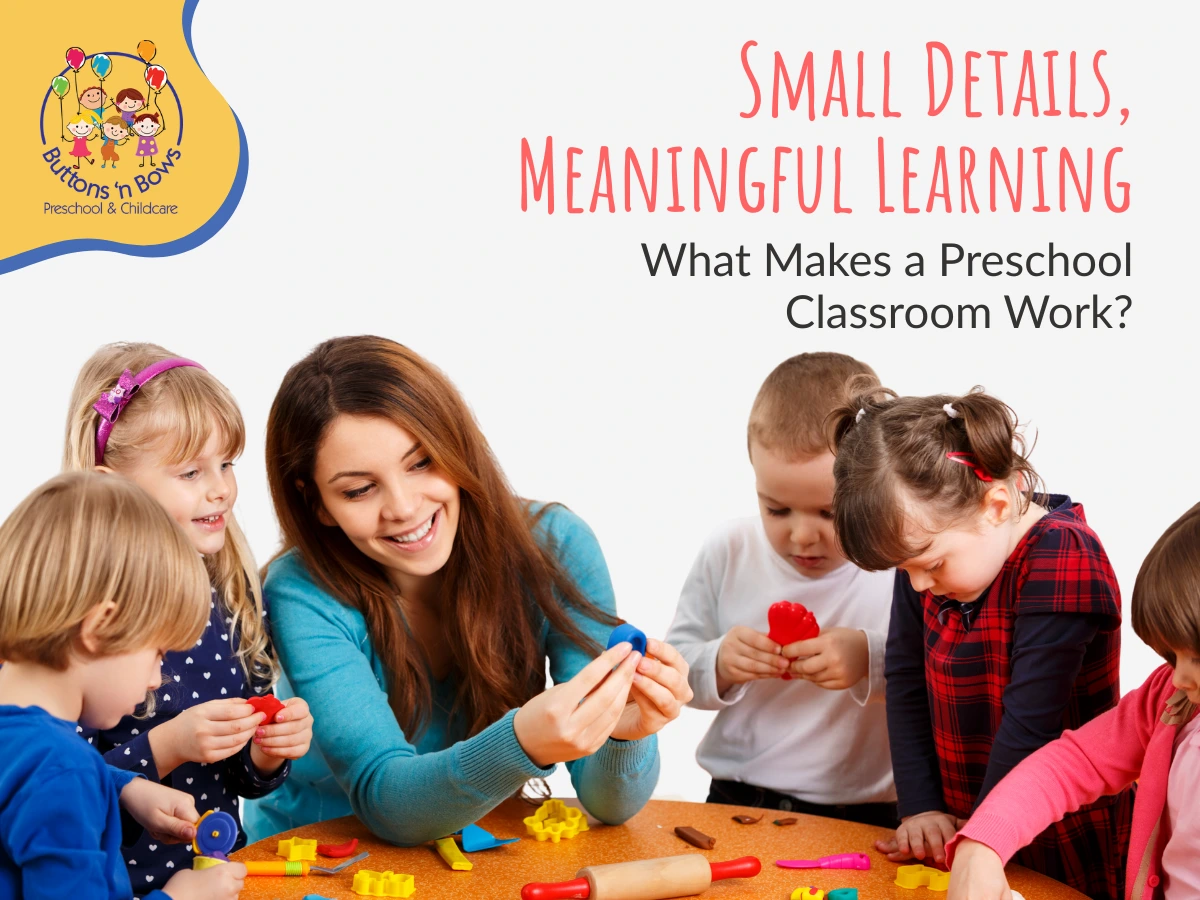
At Buttons ‘N Bows, educational play is a meaningful part of the day. Children are encouraged to explore, experiment, make choices, solve simple problems, and use their imaginations. Language naturally grows alongside those experiences because children have a reason to listen and something they want to say.
Everyday Routines Become Early Language Development Activities
Some of the best language-building moments in a toddler classroom are also the most ordinary.
- Putting on shoes.
- Washing hands.
- Sitting down for lunch.
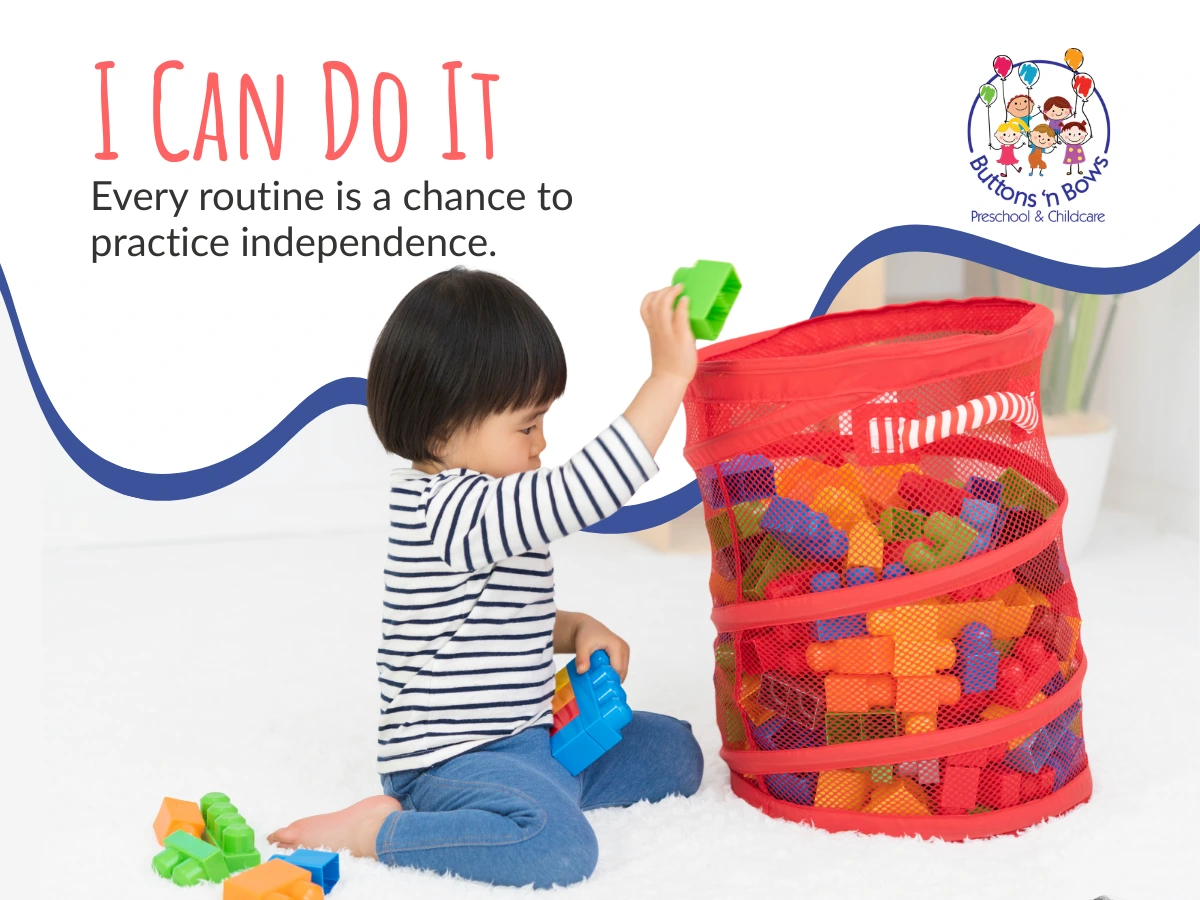
- Cleaning up toys.
- Getting ready to go outside.
These routines happen again and again, which gives children repeated exposure to useful words and short phrases.
During handwashing, a teacher might say:
“Turn on the water.”
“Now we need soap.”
“Rub your hands together.”
“Let’s rinse.”
“Time to dry.”
A child is learning far more than the steps of a routine. They are hearing action words, sequencing language, object names, and familiar phrases while physically taking part.
Because the experience repeats, the language begins to stick.
A toddler may first understand the word shoes when a teacher says it. Then they may point to them. Later they might say “shoes,” then “my shoes,” and eventually, “I do shoes.”
That is one of the things our teachers often see in toddler classrooms: language can emerge in layers.
A child may first watch during a familiar routine, then anticipate what comes next, then begin using one word from the interaction, and eventually communicate more independently.
Language and confidence often grow together.
Songs, Books, and Rhymes Give Toddlers Language They Can Join
Toddlers have a remarkable ability to enjoy the same song or story again and again.
Fortunately, repetition is one of the ways young children learn.
Familiar songs, rhymes, finger plays, and books allow toddlers to hear the same words and sound patterns repeatedly. Over time, they begin anticipating what comes next.
A teacher pauses during a favorite song, and a child fills in the missing word.
A familiar book reaches the page with the dog, and someone calls out, “Woof!”
A rhyme begins, and little hands already know what motions are coming.
Children are no longer simply listening. They are participating.
Books also introduce vocabulary that may not come up during an ordinary morning. A story can take children to a farm, under the ocean, into the woods, or all the way to the moon without leaving the classroom.
And when a teacher pauses to notice what children are looking at, responds to their comments, or wonders aloud about what might happen next, story time becomes a conversation rather than just a reading activity.
That is where early literacy begins too, long before a child is expected to read.
A Language-Rich Classroom Is Full of Conversation
Language development is not only about learning more words.
Toddlers are also discovering how communication works between people.
They begin practicing how to:
- ask for help
- express a preference
- respond to another person
- take turns in conversation
- explain what they want
- participate in play with others
Sometimes those lessons happen very peacefully.
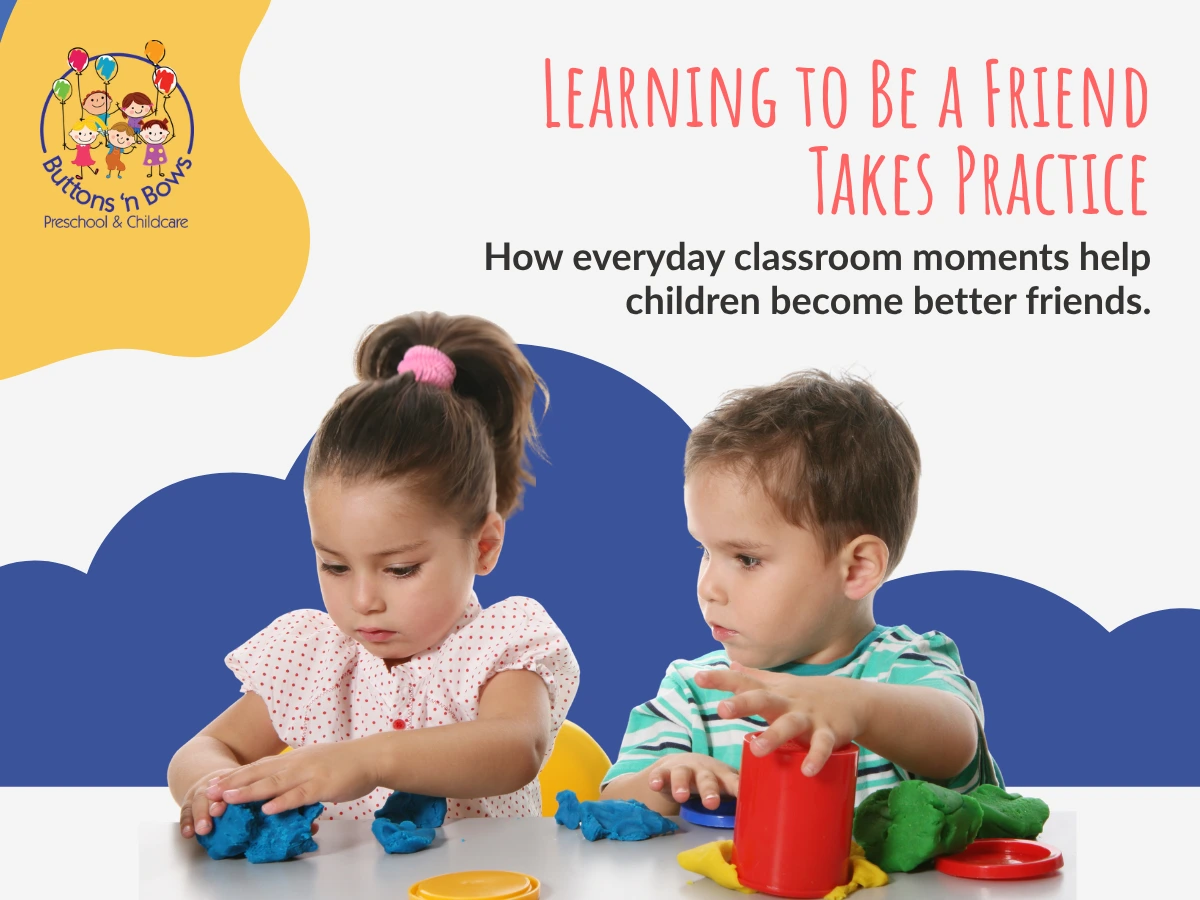
Other times, they happen because two children want exactly the same toy at exactly the same moment.
A teacher can help put words around the situation:
“You are playing with the truck right now.”
“Sam would like a turn.”
“You can tell him, ‘My turn.’”
“We can give Sam the truck when you’re finished.”
Now language is helping children do more than label an object. It is helping them work through a social moment.
In our toddler classrooms, conversation might grow from a favorite song, a child showing a teacher something they built, or the very important business of deciding who gets the red truck next.
Those everyday interactions support vocabulary, but they also help children build confidence, relationships, emotional expression, independence, and early problem-solving skills.
Teachers Can Build Language Without Turning Everything Into a Quiz
Adults naturally want to encourage young children to talk, but language development does not require a constant stream of questions.
“What color is this?”
“What is that?”
“How many do you see?”
Those questions have their place, but conversation often becomes richer when adults also describe, respond, and wonder.
If a child is painting, a teacher might say:
“You covered the whole page with blue.”
Then:
“Now you added yellow. Look what happened where the colors mixed.”
If a toddler finds a worm outside:
“You found a tiny worm in the dirt. It’s wiggling.”
That makes communication feel collaborative rather than like a test.
How Parents Can Boost Toddler Language Development at Home
Supporting language development at home can be surprisingly simple. Many of the most useful strategies fit naturally into routines you already have.
1. Talk Through Ordinary Moments
Describe what you are doing while getting dressed, preparing dinner, driving, or cleaning up.
“You found your blue sock.”
“I’m cutting the banana.”
“We’re putting the books back on the shelf.”
Simple narration helps children connect words with real actions and objects.
2. Expand Instead of Correcting
If your toddler says, “Car go,” you do not need to correct the grammar.
You might simply respond:
“Yes, the car is going fast.”
That gives them a slightly more complete model while still validating what they were trying to say.
3. Follow Their Interest
Children tend to communicate more when the topic matters to them.
If your toddler notices a dog, talk about the dog.
If they are fascinated by trucks, talk about trucks.
If they want to read the same book again, read it again.
Following their attention makes language more meaningful.
4. Give Them Time to Respond
Toddlers often need a little longer to process what they hear and decide how they want to respond.
A short pause can give them the chance to gesture, make a sound, attempt a word, or form a phrase instead of having an adult answer for them.
5. Keep Familiar Songs and Books in the Rotation
Repetition may feel repetitive to adults, but children benefit from it.
Knowing what comes next gives toddlers the confidence to join in, complete a phrase, make a sound, or say a familiar word.
Growing Language One Conversation at a Time
At Buttons ‘N Bows, our toddler classrooms are designed around the way young children actually learn: through relationships, movement, repetition, exploration, play, and hands-on experiences.
Our Jellyfish classroom supports younger toddlers during an especially active period of growth, while our Seals & Otters program gives older toddlers opportunities to learn alongside children at a similar developmental stage.
Across both, language is woven into the day rather than saved for one lesson.
It happens while a teacher comforts a child.
During a favorite story. While children explore materials together. At lunch. Outside. During songs. In the middle of pretend play.
And during hundreds of small conversations that may seem simple in the moment but become meaningful over time.
That is how children begin to understand that their words matter, their ideas are worth sharing, and the people around them are ready to listen.
Want to see how conversation, play, routines, and relationships come together in a Buttons ‘N Bows toddler classroom? Explore our toddler programs or schedule a tour to experience a typical day with us.