A little one walks in, hangs her backpack on a hook, glances around the room, and settles at the puzzle table without waiting for a single reminder. A few minutes later, she asks a friend for the missing corner piece, completes the puzzle, and returns the box to the shelf before choosing something new. None of that looks like a formal lesson, yet each small moment is a quiet win. These are exactly the kinds of preschool activities that build independence, and they matter far more than they appear.
Independence in the early years isn’t about doing everything alone. It’s about learning to try, to choose, to follow familiar routines, and to ask for help when it’s genuinely needed. At Buttons ‘n’ Bows, we see these moments play out every single day, and below, we’ll walk through how ordinary preschool experiences help children grow into confident, capable members of our classroom community.
What Classroom Independence Really Means in Preschool
Let’s clear up a common misunderstanding first. Independence doesn’t mean a three- or four-year-old should manage every task without support. A more honest picture looks like this: a child who tries before giving up, follows a familiar sequence, makes a small choice, cares for their belongings, and speaks up when something feels tricky.
Think of it as guided independence. A teacher shows a child how something works, offers a gentle cue, gives them room to try, and steps back a little more each time. Skills develop at different rates, and many preschoolers are only just beginning to string these habits together. That’s completely normal, and it’s the whole point of these years.
Why Independence Helps Children Feel Ready for the Classroom
When a child can begin a task, stick with it, and shift gears when it’s time to clean up, classroom life feels far less overwhelming. These everyday abilities help children remember familiar steps, stay engaged, respond to changes, and participate more confidently in classroom routines. They grow through relationships, repetition, and plenty of supportive practice, not through pressure.
Over time, these experiences can make a real difference. A child who is used to following familiar routines may move through classroom transitions with greater ease. A child who has practiced making small choices may be more willing to begin an activity without waiting for an adult to direct every step. And a child who has learned to ask for help tends to feel calmer and more capable when a challenge pops up. For a broader look at how these skills connect to kindergarten, our kindergarten transition guide covers wider readiness in more detail.
Preschool Self-Help Skills That Build Practical Independence
Practical independence is all about caring for one’s body and belongings. Preschool self-help skills show up dozens of times each day, and every repetition quietly strengthens a child’s confidence.
While every classroom has its own rhythm, the following activities are common examples of how children practice independence in early childhood settings:
- Arrival and belongings. Hanging up a coat and placing a bag in the right spot builds organization and eases busy drop-off and pick-up moments.
- Getting ready for outdoor play. Pulling on a jacket or managing shoes, even with a little help, develops coordination and patience.
- Handwashing. Following a simple, familiar sequence teaches children to manage a multi-step routine with fewer verbal reminders over time.
- Snack time. Helping to pass items or clear a spot builds responsibility and a quiet sense of contribution.
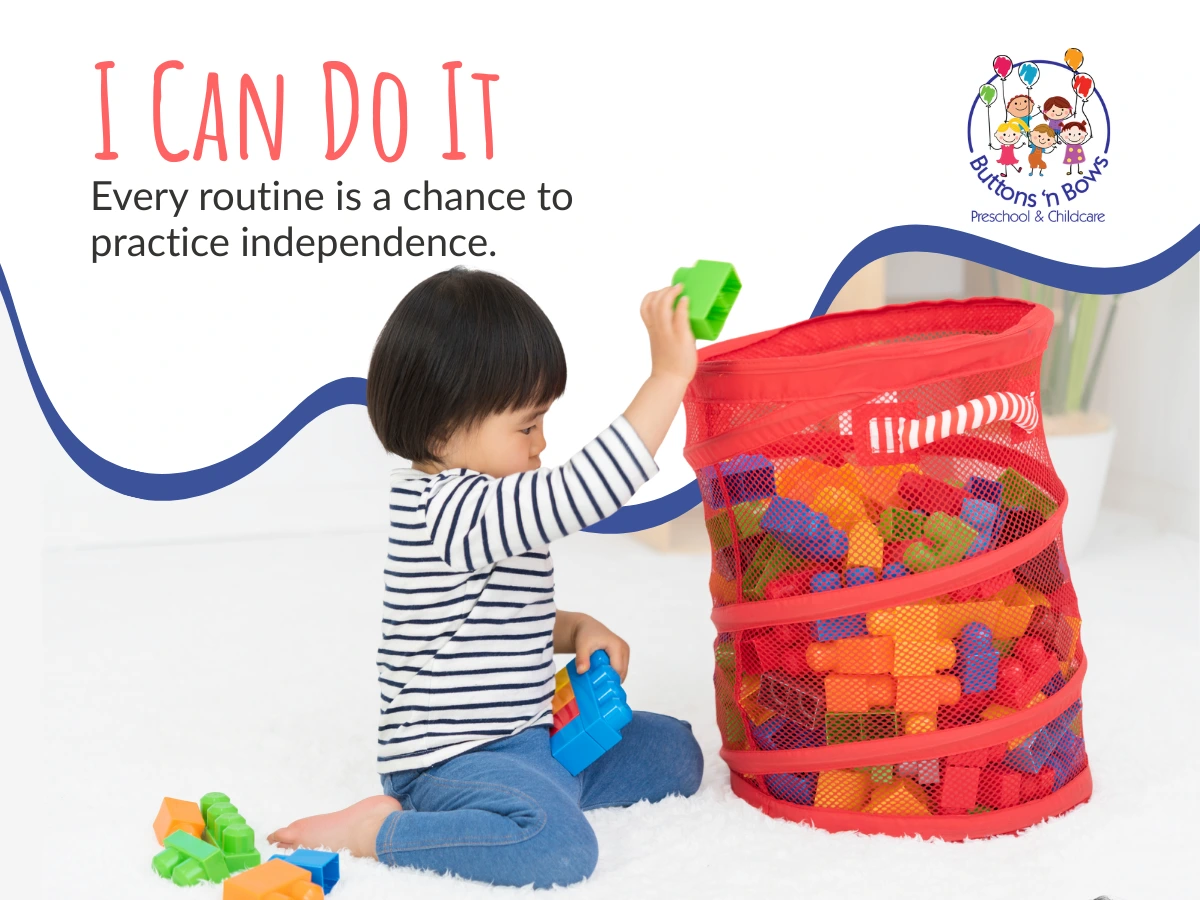
- Cleaning up. Returning materials to where they belong supports sequencing and a satisfying sense of completion.
Perfection isn’t the goal. A jacket zipped unevenly or a slightly wobbly stack of blocks still counts. What matters is the effort and the practice.
Activities That Build Independent Learning Skills for Preschoolers
Independent learning involves a slightly different set of skills. Here, we’re talking about the habits that help preschoolers become more independent learners: the ability to start a task, stay with it, and work through small problems along the way.
Several familiar activities can support these skills:
- Offering limited choices. Deciding between two appropriate activities gives children ownership without overwhelming them. Choices work best when they stay simple and manageable.
- Puzzles and small projects. These encourage children to concentrate, work through manageable challenges, and see a task through to the end.
- Open-ended art and building. When a tower falls, or a drawing doesn’t match the picture in a child’s mind, the child has an opportunity to adjust and try again. That habit of trying, reflecting, and making another attempt is an important part of becoming a confident learner.
- Child-led curiosity. Following a child’s question can open the door to meaningful exploration that feels genuinely relevant.
This is where play does much of its quiet, powerful work. Families can explore this further in our article on how play builds curiosity and confidence, or find additional hands-on ideas in our guide to play-based learning activities.
Classroom Independence Activities for Social and Routine Skills
Some of the most valuable classroom independence activities are social. Learning to work alongside others, express a need, and move through the day’s rhythm are skills children practice constantly in a group setting.
You might see this play out through:
- Helper roles. Being “in charge” of a small task teaches children that everyone contributes to the classroom community.
- Group games and movement. Starting, stopping, waiting for a turn, and responding to a shared cue all build self-regulation.
- Transition routines. Moving from circle time to centers, or from indoor play to outside, helps children learn to shift gears with less prompting.
- Pretend-play scenarios. Acting out everyday situations gives children a safe space to practice asking for a turn, expressing a need, or requesting help.
- Working through a minor disagreement. With a teacher nearby, children can begin learning how to express what happened, hear another perspective, and find a simple solution rather than relying on an adult to settle every small conflict.
And here’s something worth remembering: asking for help is part of being independent. Recognizing when you need a hand and communicating that clearly is a genuine skill, not a step backward.
How Teachers Support Independence Without Expecting Too Much
Independence never grows from pulling support away too soon. The strongest approach is gradual, and it tends to follow a gentle sequence:
- Model the task so the child sees how it’s done.
- Do it together the first few times.
- Offer a cue or a simple reminder.
- Give the child time to try it themselves.
- Step in for the tricky part or when frustration begins to build.
- Ease back as confidence grows.
Teachers can observe when a child needs more time, a small reminder, or a helping hand. They step in right away for safety, break a hard task into smaller pieces, and celebrate effort rather than a flawless result. Children thrive when they feel seen, safe, and connected, and that sense of security is what gives them the courage to try in the first place.
Supporting the Same Skills at Home
You don’t need to turn home into a classroom to support these habits. In fact, the smallest everyday moments, such as a predictable morning routine, an extra minute to put on shoes, or the chance to choose between two snacks, can quietly build the same confidence children are practicing at preschool.
A few things that tend to help:
- Keep routines predictable so your child knows what comes next.
- Store coats, cups, and belongings where little hands can reach them.
- Offer two manageable choices rather than an open-ended “what do you want?”
- Build in extra time so your child can try without feeling rushed.
- Use specific encouragement. Something like “you kept trying until it worked” lands better than a general “good job.”
If your child seems more independent at preschool than at home, that doesn’t mean anything is wrong. Preschool and home are different environments, and children often respond differently in each one. Familiar routines, group participation, and seeing other children try can sometimes make a task feel easier at school. At home, a child may be tired, relaxed, or simply looking for reassurance from a parent.
Neither response automatically means that anything is wrong. The goal isn’t a perfect level of independence by a certain age. It’s steady, supported practice, one small moment at a time.
Growing Confident Learners at Buttons ‘n Bows
For more than 40 years, Buttons ‘n Bows has been a locally owned part of Utah family life, and the ideas behind these examples reflect what we believe early childhood learning should look like: purposeful play, familiar routines, caring relationships, and plenty of opportunities for children to try things for themselves. Our two locations, in Holladay and Cottonwood Heights, are built around that same philosophy.
Our three-year-old Stingrays program introduces routines, sharing, group participation, music, and Spanish, while our four-year-old Turtles program continues building the social-emotional and academic foundations children need for kindergarten. Our teachers support that growth with training in childcare and child development, along with CPR and first aid certification.
The best way to understand how these skills grow is to see them in action. Explore our preschool and Pre-K programs, and schedule a tour when you’re ready. We’d love to show you how supportive teachers, purposeful play, and familiar daily routines help your child grow in confidence, one small step at a time.
Frequently Asked Questions About Preschool Independence
What activities help preschoolers become more independent?
Everyday activities such as managing belongings, washing hands, cleaning up materials, making limited choices, completing puzzles, participating in group games, and asking for help can all support growing independence.
What self-help skills should preschoolers practice?
Preschoolers may begin practicing dressing, handwashing, eating, cleaning up, managing personal items, following familiar routines, and communicating when they need assistance. Children develop these abilities at different rates and may still need plenty of adult support along the way.
Is asking for help part of being independent?
Yes. Independence includes recognizing when a task requires support and being able to communicate that need clearly. The goal is not for children to do everything alone, but to participate confidently and use help appropriately.
Why is my child more independent at preschool than at home?
Preschool and home are different environments. Familiar routines, group participation, and watching other children try may sometimes make a task feel easier at school. At home, children may be tired, relaxed, or looking for additional reassurance from their parents.